Engineering Physics
Electrodynamics & Maxwell’s Equations
Unit III: Introduction to Electrodynamics. This unit explains the behaviour of time varying electromagnetic fields, Faraday's law, displacement current, the generalized Ampere law and the complete set of Maxwell's equations. It concludes with electromagnetic wave formation and propagation in free space.
Time Varying Fields
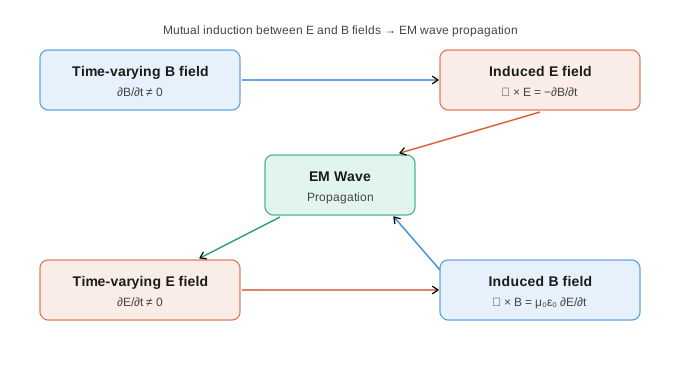
- A field that changes with time produces coupling between electric and magnetic fields.
- A time varying magnetic field produces an induced electric field and a time varying electric field produces a magnetic field.
- These interactions form the basis of electromagnetic wave propagation.
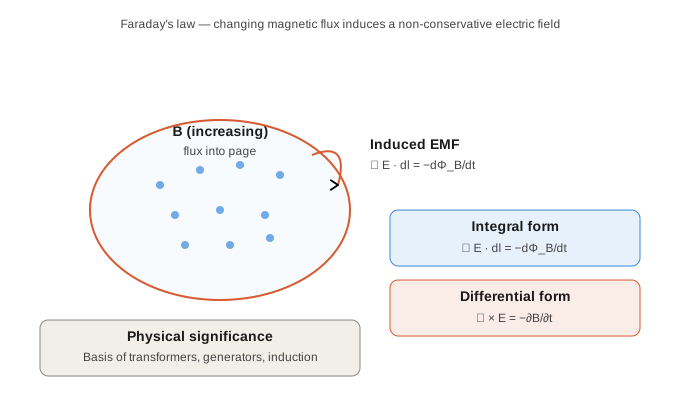
Faraday's Laws of Electromagnetic Induction
- Integral form:
∮ E · dl = - dΦ_B/dtThe induced EMF equals the negative rate of change of magnetic flux. - Differential form:
∇ × E = - ∂B/∂tChanging magnetic field induces a non conservative electric field. - Physical significance: induction without physical contact, rotational electric fields, basis of transformers and electric generators.
Displacement Current Density
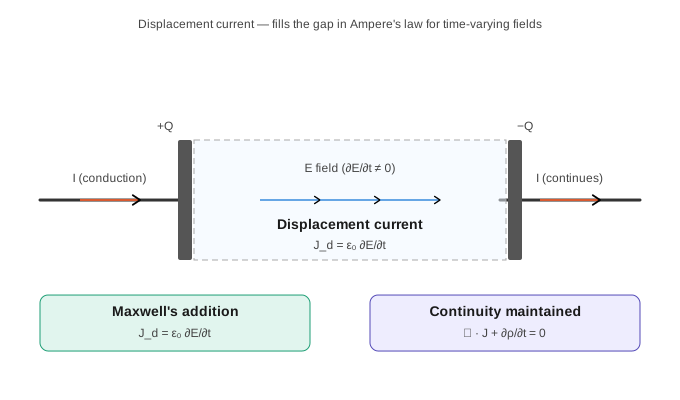
- Proposed by Maxwell to maintain continuity in Ampere's law for time varying fields.
- Defined as
J_d = ε0 ∂E/∂t. - Arises in regions where no conduction current exists such as the gap of a capacitor.
- Essential for forming a consistent framework for electromagnetic waves.
Generalized Ampere Law
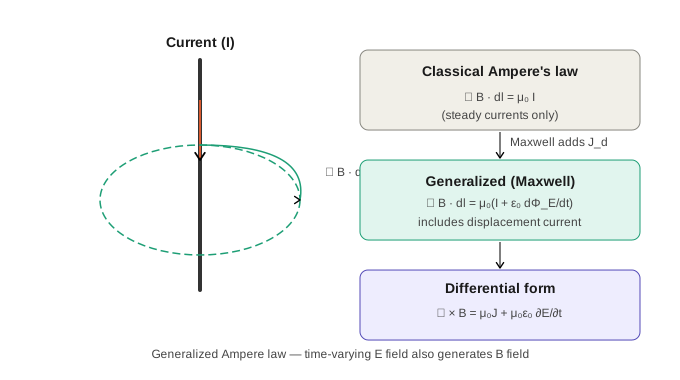
- Classical Ampere law applies only to steady currents. Maxwell added displacement current.
- Integral form:
∮ B · dl = μ0 (I + ε0 dΦ_E/dt). - Differential form:
∇ × B = μ0 J + μ0 ε0 ∂E/∂t. - Shows that time varying electric fields generate magnetic fields.
Maxwell's Equations
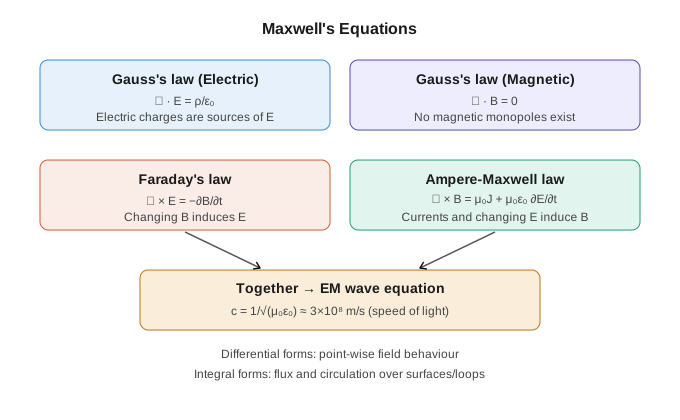
- Gauss Law for Electricity:
∇·E = ρ/ε0. - Gauss Law for Magnetism:
∇·B = 0. - Faraday's Law:
∇ × E = - ∂B/∂t. - Ampere Maxwell Law:
∇ × B = μ0 J + μ0 ε0 ∂E/∂t. - Integral forms represent flux and circulation relationships. Differential forms express point-wise local field behaviour.
Electromagnetic Waves in Free Space
- Combining Maxwell equations results in the electromagnetic wave equation.
- Wave equation for electric field:
∇²E = μ0 ε0 ∂²E/∂t². - Wave equation for magnetic field:
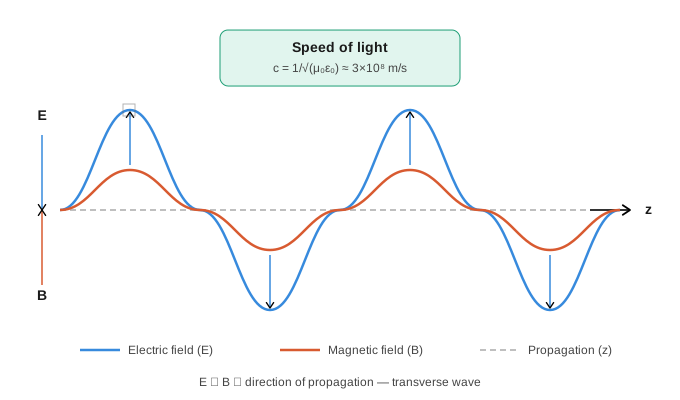
∇²B = μ0 ε0 ∂²B/∂t². - Plane waves propagate with speed
c = 1/√(μ0 ε0). - Electric field and magnetic field are mutually perpendicular and also perpendicular to the direction of propagation.
This unit builds the complete foundation for understanding electromagnetic wave behaviour, antennas and communication theory. If you want a short revision sheet, ask for the Unit III cheat sheet.
Ready to test your Chapter III: Electrodynamics and Maxwell’s Equations knowledge?
Chapter III: Electrodynamics and Maxwell’s Equations
A short module quiz for Chapter 3 covering Faraday's law, displacement current, Maxwell's equations, and electromagnetic wave propagation.