Engineering Physics
Vector Algebra & Fields
This chapter introduces the fundamental vector calculus operators used throughout electromagnetism: gradient, divergence, curl, and the integral theorems of Gauss and Stokes. These concepts form the mathematical backbone of Maxwell’s equations.
Gradient, Divergence and Curl
Lecture 1, 2 and 3
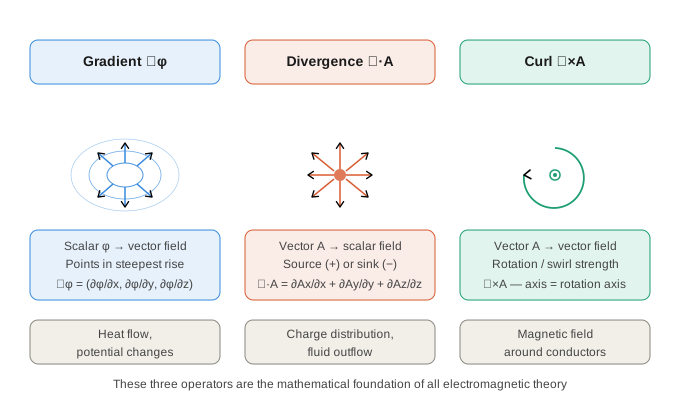
- Gradient: Measures the rate and direction of maximum change of a scalar field. If
φ(x, y, z)is a scalar field,∇φgives its directional variation. - Divergence: Indicates the “outflow” from a point in a vector field. For vector field
𝐀,∇·𝐀shows whether the point acts as a source or sink. - Curl: Represents the rotation or swirling strength of a vector field. Curl of
𝐀is∇×𝐀. - **Physical significance** (important for exams):
- Gradient → direction of steepest change (heat flow, potential changes).
- Divergence → net flux outward (electric charge distribution, fluid outflow).
- Curl → rotational field strength (magnetic field around conductors).
Gauss’ Theorem & Stokes’ Theorem
Lecture 4 and 5
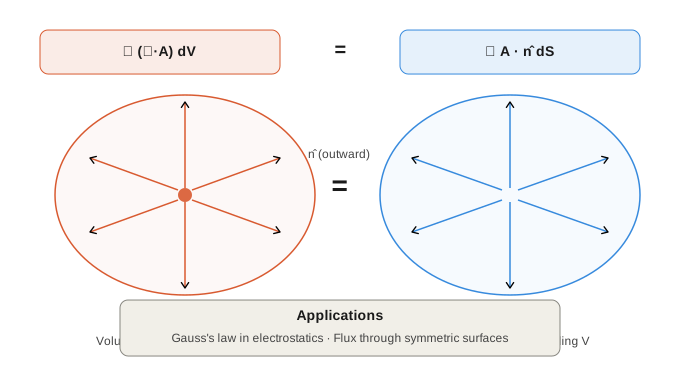
- Gauss’ Divergence Theorem: Converts a surface integral into a volume integral:
∭ (∇·𝐀) dV = ∬ 𝐀·n̂ dS. Useful in electrostatics for deriving Gauss’ law. - Applications:
- Flux calculation for symmetric charge distributions.
- Simplifying electric field evaluation using closed surfaces.
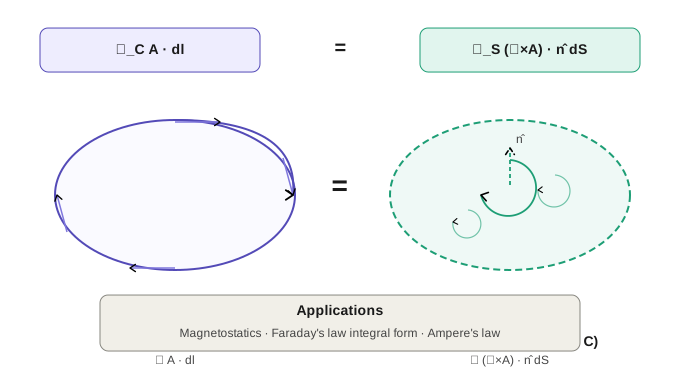
- Stokes’ Theorem: Relates a line integral to a surface integral of the curl:
∮ 𝐀·dl = ∬ (∇×𝐀)·n̂ dS. - Applications:
- Used in magnetostatics: circulation of magnetic field.
- Provides basis for integral Maxwell–Faraday law.
This chapter establishes the vector calculus tools required to understand electrostatics, magnetostatics, and electromagnetic waves in later modules. For a rapid revision, ask:“Make Ch1 cheat sheet”.
Ready to test your Chapter I: Vector Algebra & Fields knowledge?
Chapter I: Vector Algebra & Fields
A short module quiz for Chapter 1 covering gradient, divergence, curl, and the integral theorems of Gauss and Stokes.
5 questions·No time limit·Instant feedback