Engineering Physics
Electrostatics & Magnetostatics
Unit II: Electrostatics and Magnetostatics. This chapter summarises the essential physical laws that describe electric and magnetic fields, electric potential, flux, and the governing integral and differential relations used throughout electromagnetic theory.
Electrostatics: Electric Field and Charge Interaction
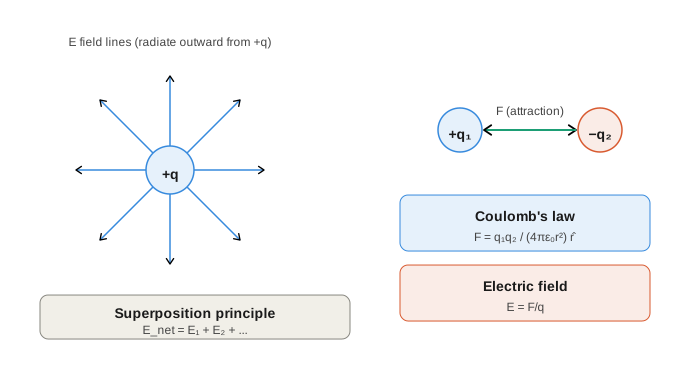
- Coulomb's Law gives force between two point charges.
F = (1/(4πε0)) * q1*q2 / r^2 * r̂. - Principle of Superposition states that the net electric field is the vector sum of fields produced by all charges.
- Electric Field at a point is the force per unit positive test charge:
E = F/q.
Electrostatic Potential and Potential Energy
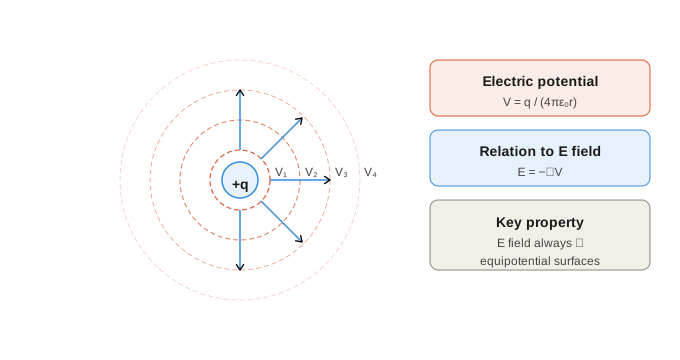
- Electrostatic Potential V is the work done per unit charge in bringing a test charge from infinity to a point in the field.
- Relation between potential and field:
E = -∇V. - Potential Energy of a charge system equals the work needed to assemble charges from infinity.
- Potential Gradient gives the spatial rate of change of potential and points in the direction of maximum decrease of potential.
Electric Flux, Displacement Vector and Gauss' Law
- Electric Flux:
Φ = ∬ E·dS. Represents the number of field lines passing through a surface. - Electric Displacement Vector D relates to free charge in materials and helps simplify field calculations in dielectrics.
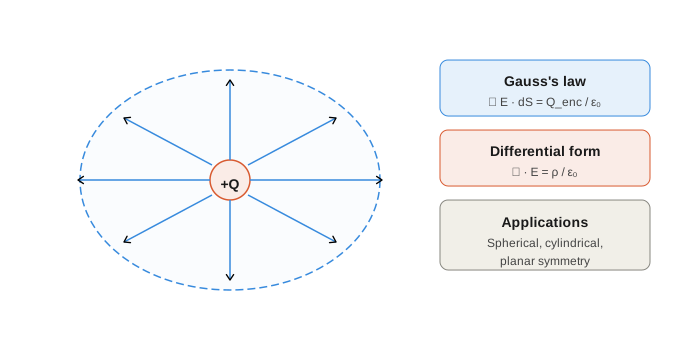
- Gauss' Law in integral form:
∮ E·dS = Q_enclosed / ε0. - Gauss' Law in differential form:
∇·E = ρ / ε0. - Derivation of Coulomb's Law from Gauss' Law uses spherical symmetry around a point charge to obtain the inverse square relationship.
Magnetostatics: Magnetic Field and Force
- Magnetic Field B describes the magnetic influence at a point in space.
- Magnetic Flux:
Φ_B = ∬ B·dS. - Magnetic Flux Density is another name for B, measured in Tesla.
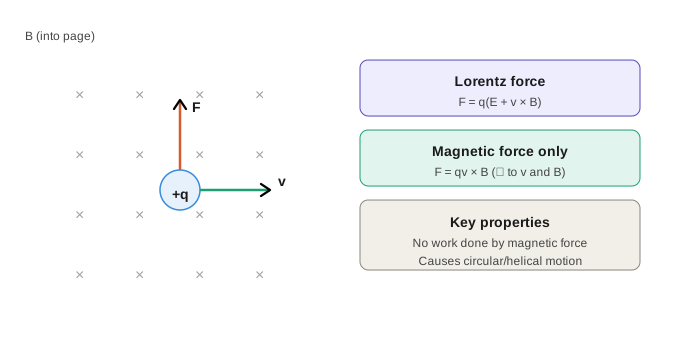
- Lorentz Force on a moving charge:
F = q(E + v × B).
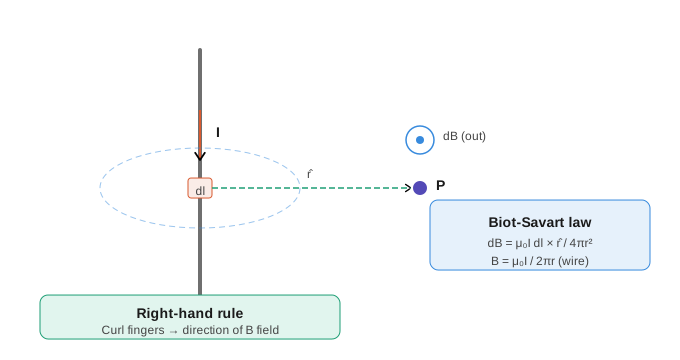
Biot Savart Law
- Gives magnetic field produced by a steady current element. Common applications include long straight conductors and circular current loops.
- Basis for deriving magnetic fields in symmetric current distributions.
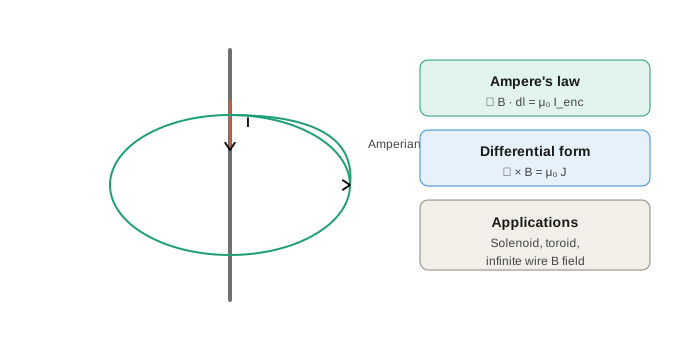
Ampere's Circuital Law
- Integral form:
∮ B·dl = μ0 I_enclosed. - Used for finding B in systems with high symmetry such as solenoids, toroids and long straight conductors.
- Complements Biot Savart Law in steady current situations.
Gauss' Law for Magnetism
- States that the net magnetic flux through any closed surface is zero:
∮ B·dS = 0. - Differential form:
∇·B = 0. - Implies that magnetic monopoles do not exist.
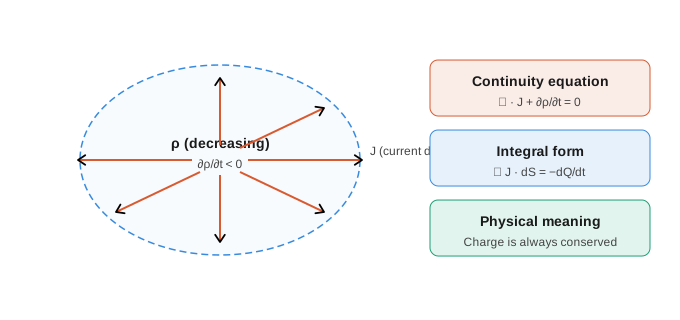
Equation of Continuity
- Expresses conservation of charge:
∂ρ/∂t + ∇·J = 0. - Links time variation of charge density with divergence of current density.
This unit forms the foundation for studying electromagnetic waves and Maxwell's equations. If you want a compact revision sheet, ask for the Unit II cheat sheet.
Ready to test your Chapter II: Electrostatics and Magnetostatics knowledge?
Chapter II: Electrostatics and Magnetostatics
A short module quiz for Chapter 2 covering Coulomb's law, electric field, potential, Gauss' law, magnetic fields, Biot-Savart, and Ampere's circuital law.
5 questions·No time limit·Instant feedback