Programming in C
File Management, Dynamic Memory, and Preprocessors
Concise notes on file I/O, streams, command-line arguments, dynamic memory allocation, basic linked list ideas, and preprocessor directives with short examples and debugging hints.
File Management and Streams
- File operations: open, read, write, close using
fopen,fclose,fread,fwrite,fseek,ftell. - Streams: standard streams
stdin,stdout,stderr. - Command-line arguments:
int main(int argc, char *argv[]), whereargcis count andargvholds arguments. - Error handling: check return values (e.g.,
fopenmay returnNULL), useperrororstrerror(errno). - Random access: use
fseekandftellto move and query file position for binary I/O.
File Read (simple)
FILE *fp = fopen("data.bin", "rb");
if (fp == NULL) { perror("open"); exit(1); }
char buf[128];
size_t n = fread(buf, 1, sizeof(buf), fp);
fclose(fp);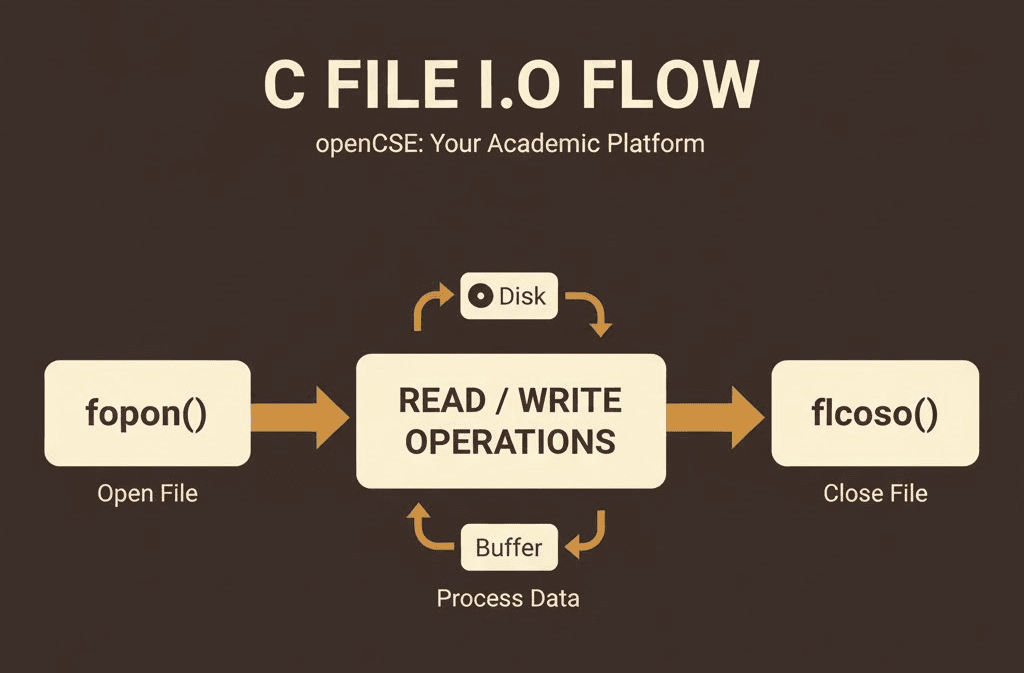
Command-line Arguments & Error Handling
- Access arguments via
argv[1]etc.; convert strings to numbers withatoi,strtol. - Always validate
argcand check conversions for errors. - Use
errno,perrorand return non-zero exit code on failure.
Dynamic Memory Allocation
- malloc: allocate uninitialized block:
void *malloc(size_t size). Check forNULL. - calloc: allocate and zero-initialize:
void *calloc(nmemb, size). - realloc: resize previously allocated block:
void *realloc(ptr, new_size). Use carefully to avoid leaks. - free: release memory:
free(ptr). Avoid double-free and use-after-free.
Dynamic array (simple)
int *a = malloc(n * sizeof(int));
if (a == NULL) { perror("malloc"); exit(1); }
... use a ...
free(a);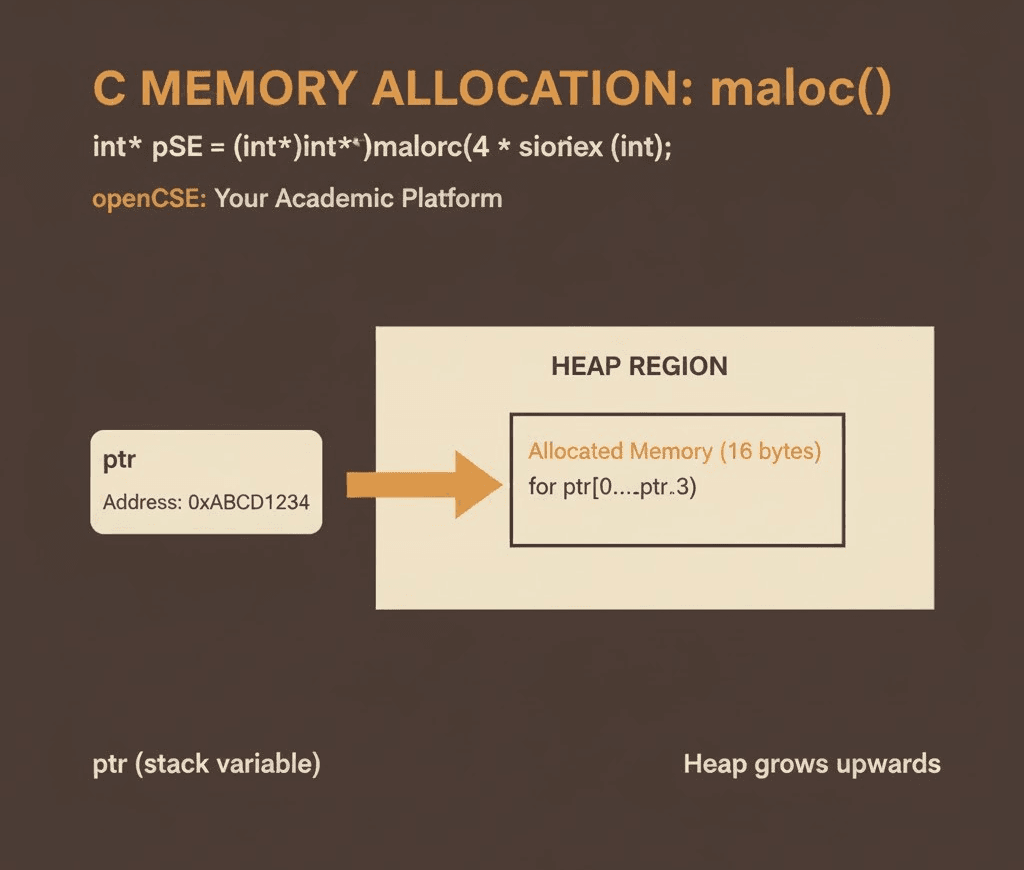
Basic Idea — Linked List
- Self-referential structure where each node points to next:
struct Node { int val; struct Node *next; };. - Create nodes with
malloc, set fields, and link via pointers; free nodes when removed. - Common ops: insert at head, delete node, traverse; watch for NULL checks.
Insert at head (sketch)
struct Node *n = malloc(sizeof *n);
n->val = v;
n->next = head;
head = n;

Preprocessor Directives
- Macro definition:
#define PI 3.14— text substitution before compilation. - Macro substitution: use parentheses in macros to avoid precedence bugs:
#define SQR(x) ((x)*(x)). - File inclusion:
#include <stdio.h>or#include "file.h". - Conditional compilation:
#ifdef,#ifndef,#if,#endif.
Macro example
#define MAX(a,b) ((a) > (b) ? (a) : (b))
int m = MAX(x, y);
Debugging Exercise
Find and fix the errors
#include <stdio.h>
#include <stdlib.h>

char *make_message() {
  char buf[64];
  snprintf(buf, sizeof(buf), "hello");
  return buf; // error: returning pointer to local stack buffer
}
Correct points
- Do not return pointer to local buffer. Allocate with
mallocor let caller provide buffer. - Check allocations and use
freeto avoid leaks. - Always close files with
fcloseeven on error paths.
Programming Exercise
- Write a program that reads a binary file of integers and prints statistics (min, max, mean) using
fread. - Implement a simple singly linked list with insert and delete operations using dynamic memory.
Diagrams to paste: file-i-o.png, malloc-layout.png, linkedlist.png. This module includes the core points required for college exams. If you want a one-page revision sheet, say "Make Ch6 cheat sheet".
Ready to test your Processes & Scheduling knowledge?
Processes & Scheduling
A short quiz for process concepts and CPU scheduling after the Processes section.
5 questions·No time limit·Instant feedback