Programming in C
Data Types, I/O, Decision Making and Loops
This chapter highlights definitions, sizes, operator precedence, control constructs, common pitfalls, and a short debugging example.
Data Concepts in C
- Constants are fixed values that do not change during execution (literal or defined via
#define). - Variables are named storage locations declared with a data type before use.
- Declaration example:
int count;orfloat avg = 0.0f;.
Data Types, Size and Values
Standard fundamental types commonly used in exams are listed below.
Common C types (typical 32-bit system)
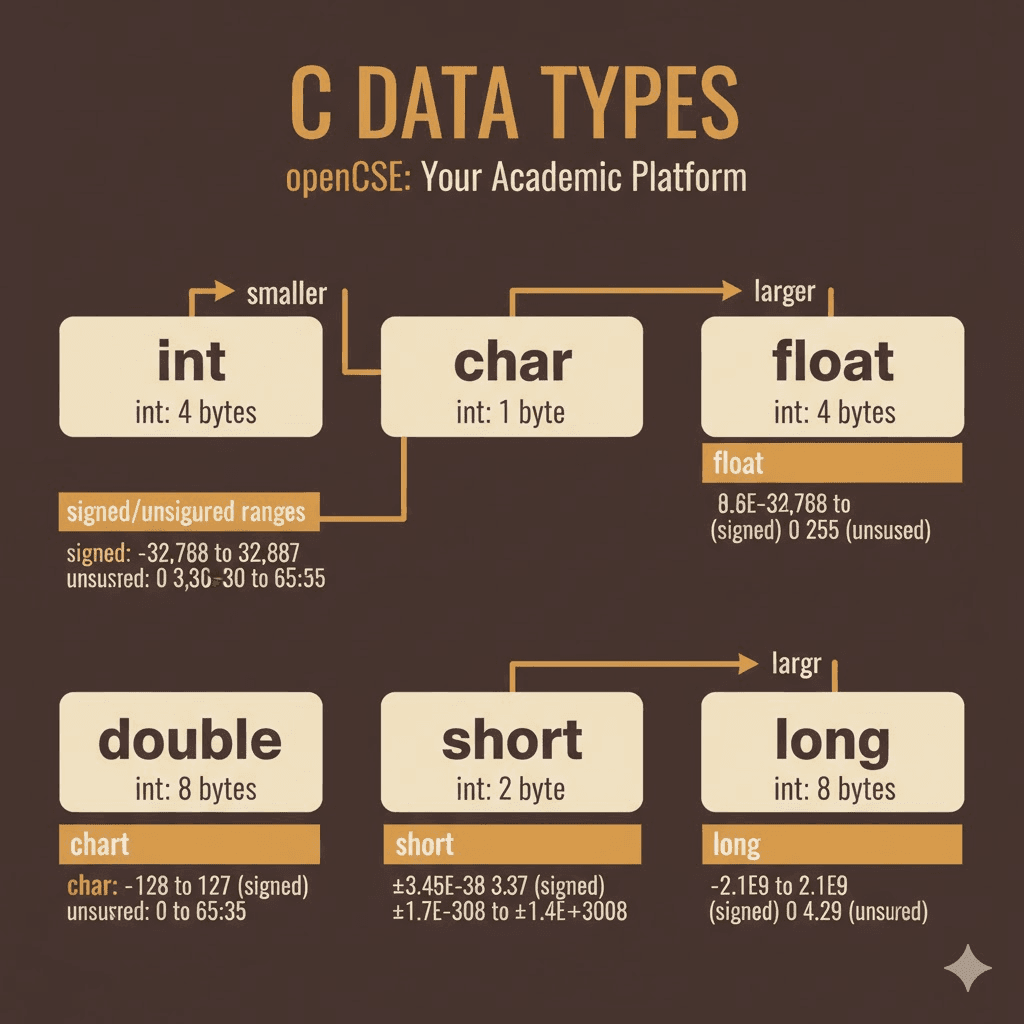
char— 1 byte, stores a character, range: typically -128 to 127 (signed) or 0 to 255 (unsigned).int— 4 bytes, range implementation-defined; commonly -2,147,483,648 to 2,147,483,647.short— 2 bytes;long— 4 or 8 bytes depending on platform.float— 4 bytes (single precision);double— 8 bytes (double precision).
Storage Classes
- auto — default for local variables (automatic storage duration).
- static — retains value between calls; internal linkage if file-scope.
- extern — declares a global variable defined elsewhere.
- register — hint to keep variable in CPU register (often ignored by modern compilers).
Remember exam questions often ask for scope and lifetime of each storage class.
Operators and Precedence
- Operator categories: arithmetic, relational, logical, bitwise, assignment, and ternary.
- Precedence determines evaluation order. Higher precedence operators evaluate first.
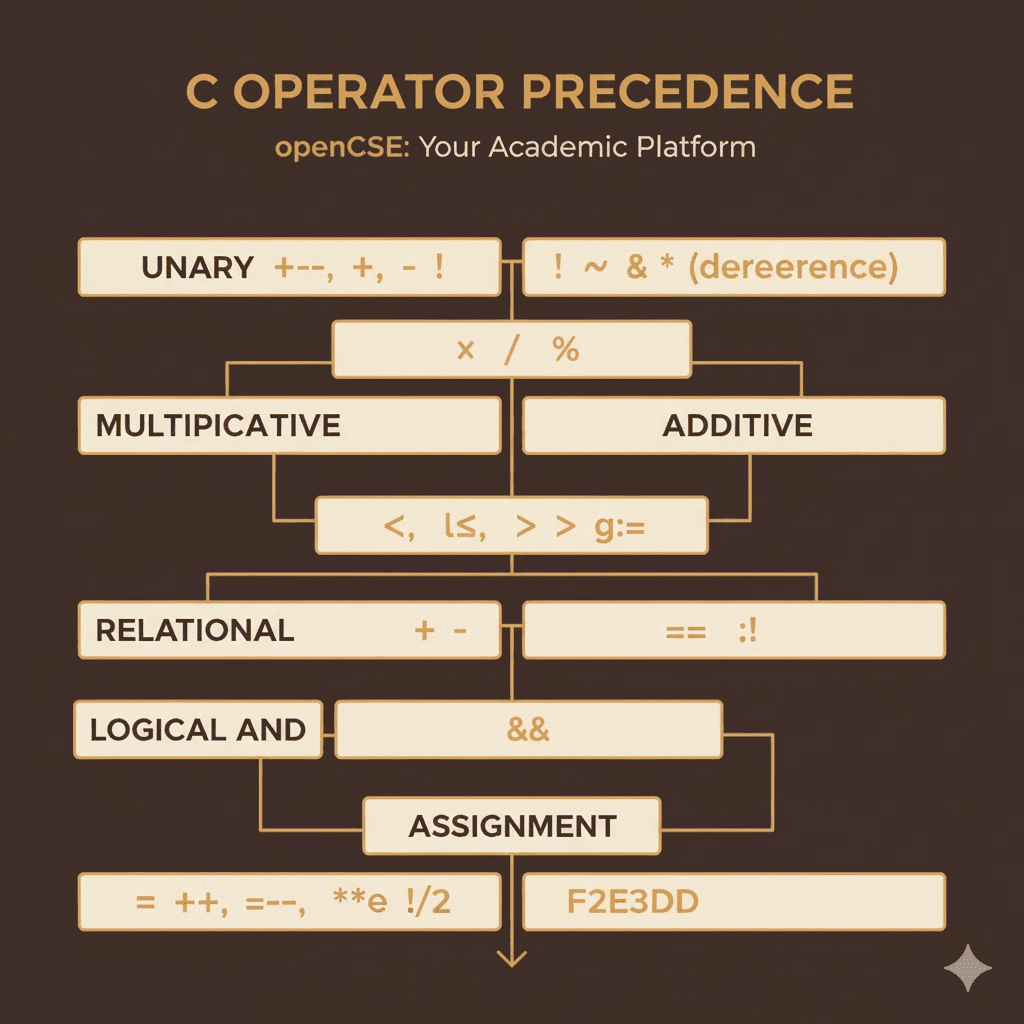
Important precedence (high → low)
- Unary:
++--+-! - Multiplicative:
*/% - Additive:
+- - Relational:
<><=>= - Equality:
==!= - Logical:
&&then|| - Assignment:
=and compound assignments
Note: use parentheses to enforce evaluation order when needed.
Operator associativity is usually left-to-right; assignment and some unary operators associate right-to-left.
Statements and Expressions
- Declaration statements: introduce variables and optionally initialize them.
- Expression statements: evaluate expressions and may produce side effects (
a = b + c;). - Compound statements (blocks): groups of statements enclosed in
{and}defining scope.
Input-Output Statements
- Standard I/O:
printf(),scanf(),puts(). - Format specifiers:
%dint,%ffloat,%cchar,%sstring. - Always pass address with
scanf()for non-array variables:scanf("%d", &x).
I/O Example
int x;
printf("Enter a number: ");
scanf("%d", &x);
printf("You entered %d
", x);
Selection Statements
- if executes a block when condition is true.
- if-else selects between two branches.
- switch selects cases based on integer/enum; use
breakto prevent fall-through. - goto exists but is discouraged; used rarely for error handling in legacy code.
if-else example
if (a > b) {
  printf("a is greater
");
} else {
  printf("b is greater or equal
");
}
switch example
switch (ch) {
  case 'a': doA(); break;
  case 'b': doB(); break;
  default: doDefault();
}
Loop Constructs
- for — initialization; condition; update. Use when count known.
- while — condition-checked before each iteration.
- do-while — body executes first, condition checked afterwards.
- Jumps —
break,continue(skip), andgoto(discouraged).
Loop examples
// for loop
for (int i = 0; i < n; i++) {
  sum += i;
}

// while loop
int i = 0;
while (i < n) {
  sum += i;
  i++;
}

// do-while
int i = 0;
do {
  sum += i;
  i++;
} while (i < n);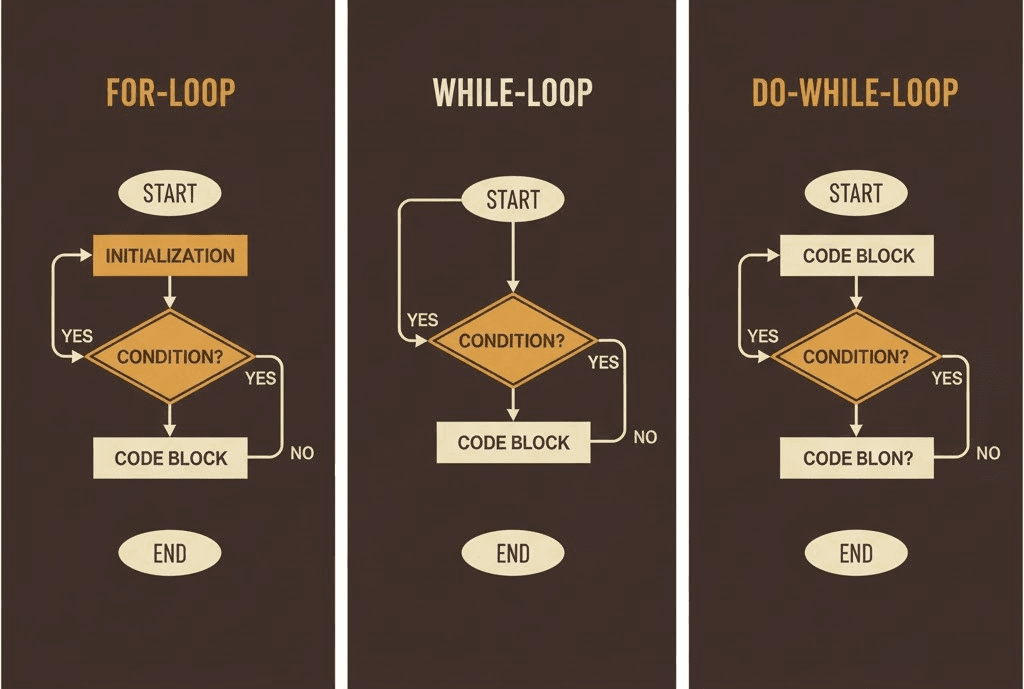
Overflow
- Overflow occurs when a calculation produces a value outside a type's range.
- Signed integer overflow is undefined behaviour in C and must be avoided.
- Unsigned overflow wraps modulo 2^n; prefer larger types or checks when needed.
Debugging Exercise
Find and fix the errors
#include <stdio.h>

int main() {
  char s[5];
  printf("Enter string: ");
  scanf("%s", s);   // possible overflow if user types >4 chars
  printf("You entered: %s
", s)
  return 0;
}
Correct points
- Ensure buffer size and use width specifier:
scanf("%4s", s); - Add missing semicolon after
printf. - Prefer
fgetsfor safer input.
Programming Exercise
- Implement a program that reads n integers and finds their sum and average, using loops and appropriate types.
- Implement factorial using iterative loop and check for overflow for large n.
Ready to test your Processes & Scheduling knowledge?
Processes & Scheduling
A short quiz for process concepts and CPU scheduling after the Processes section.
5 questions·No time limit·Instant feedback