Engineering Mathematics I
Ordinary Differential Equations
Module III: Ordinary Differential Equations. This unit introduces essential first and second order ODE techniques used in engineering. Each method includes formulas and short examples for quick revision.
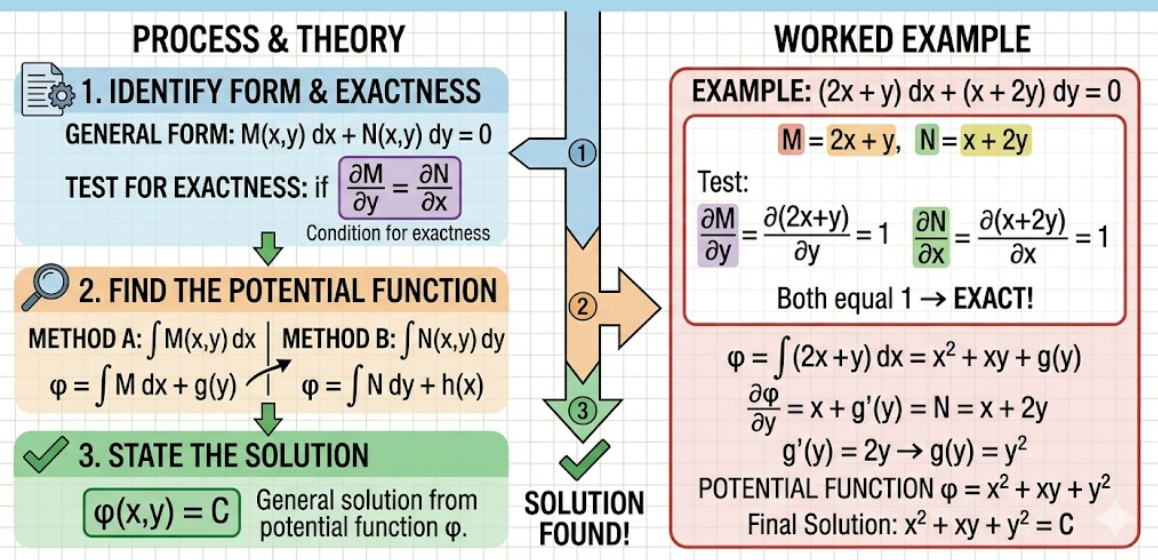
First Order Exact Equations
- General form:
M(x,y) dx + N(x,y) dy = 0. - Exact if
∂M/∂y = ∂N/∂x. - Solution obtained from the potential function
φ(x,y) = C. - Example:
(2x + y) dx + (x + 2y) dy = 0is exact since both mixed derivatives are 1.
First Order Linear Equations
- Standard form:
dy/dx + P(x) y = Q(x). - Integrating factor:
IF = e^(∫P(x) dx). - Solution:
y IF = ∫Q(x) IF dx + C. - Example:
dy/dx + y = e^x → IF = e^x.
Bernoulli Equations
- Form:
dy/dx + P(x) y = Q(x) y^n. - Converted to linear using
v = y^(1-n). - Example:
dy/dx + y = y^2 → v = y⁻¹.
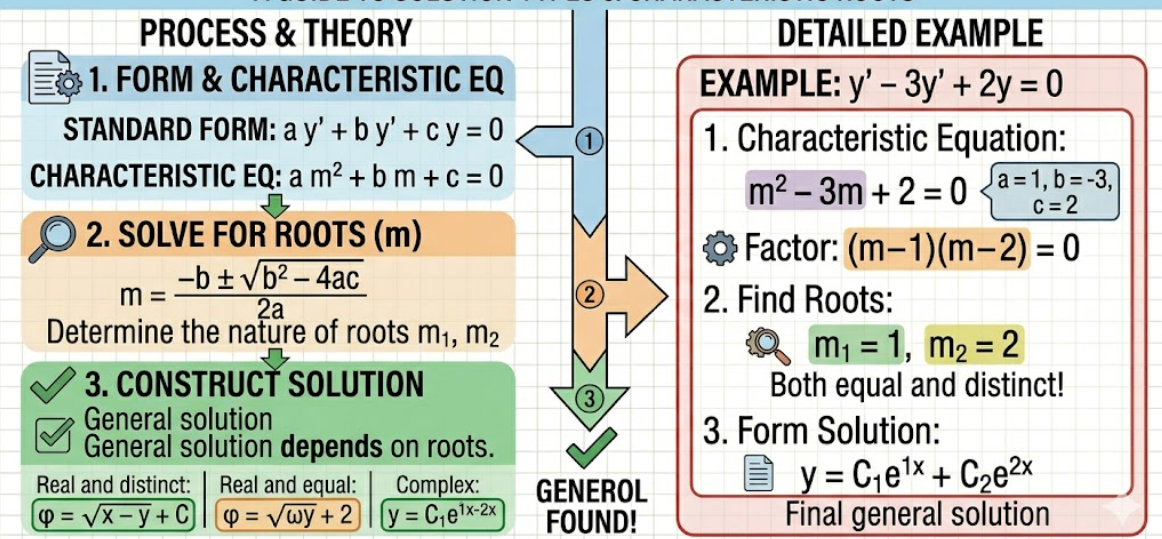
Second Order Linear Equations with Constant Coefficients
- Standard form:
a y'' + b y' + c y = 0. - Characteristic equation:
a m^2 + b m + c = 0. - Solution based on roots:
- Real and distinct:
y = C1 e^(m1 x) + C2 e^(m2 x). - Real and equal:
y = (C1 + C2 x) e^(mx). - Complex:
y = e^(αx)(C1 cos βx + C2 sin βx). - Example:
y'' - 3y' + 2y = 0 → roots 1 and 2.
Method of Variation of Parameters
- Used for non homogeneous equations
y'' + P y' + Q y = R. - Requires complementary function (CF) from the homogeneous part.
- Particular integral (PI) obtained by varying constants in CF.
- Example:
y'' + y = sin x.
Euler (Cauchy) Equations
- Form:
x^2 y'' + a x y' + b y = 0. - Substitution
x = e^tconverts it to constant coefficient form. - Example:
x^2 y'' - 3x y' + 3y = 0.
Systems of Differential Equations
- Linear systems can be solved by elimination or matrix methods.
- Example:
dx/dt = x + y , dy/dt = x - y.